
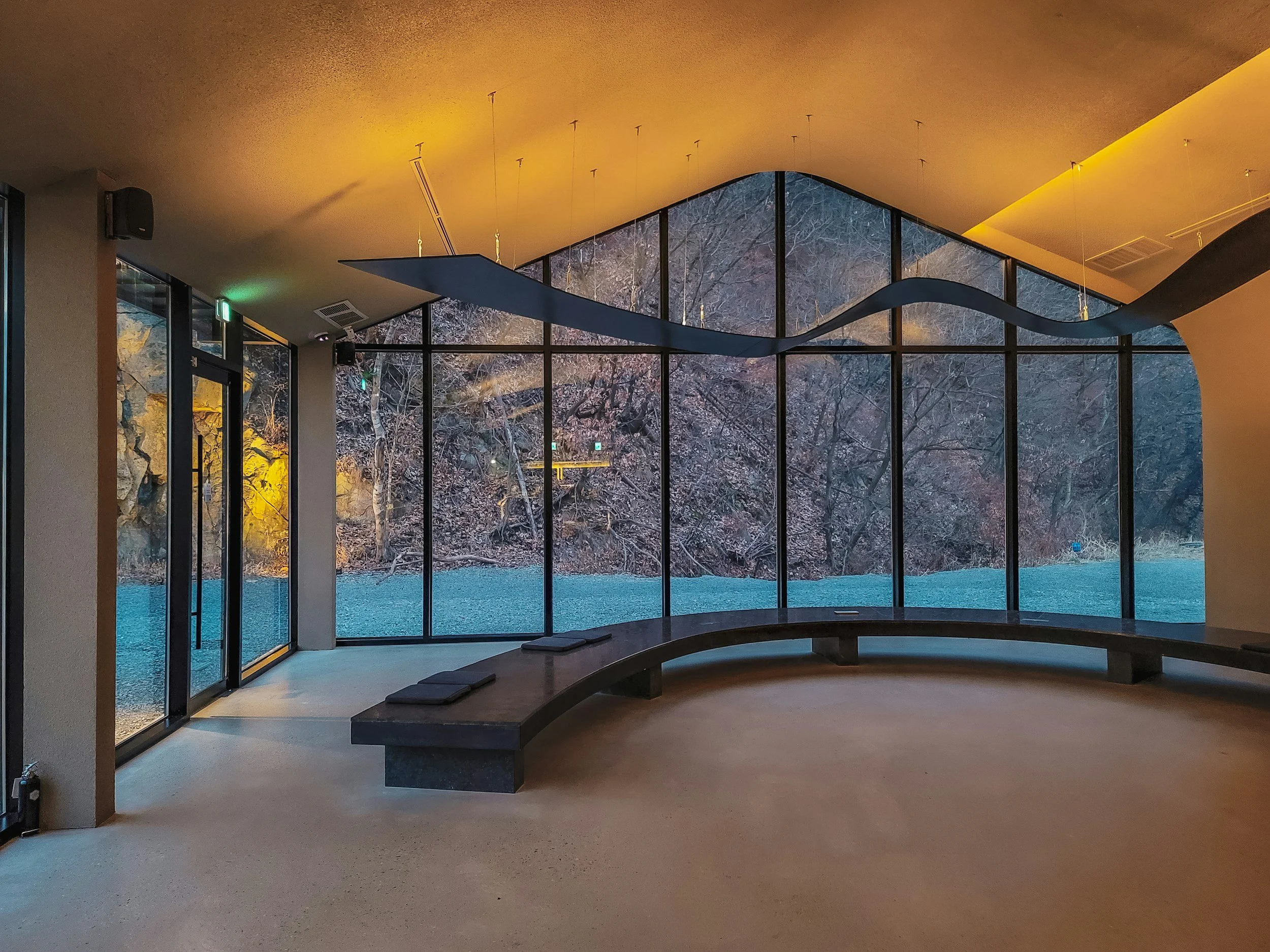
environment & experience design.
Designing spaces and systems where clarity, presence, and performance become the everyday experience.
The Outer Architecture of Human Coherence
What surrounds people shapes how they think, feel, and perform.
Environment & Experience Design translates human-layer insight into physical, sensory, and experiential conditions — spaces, cues, flows, signals, and aesthetics — so environments support clarity, steadiness, and coherence in daily use.
This work focuses on the outer layer of the Human Layer™: the conditions people inhabit every day, often unconsciously, and that quietly regulate nervous system state, attention, emotion, and behavior.
It is not about aesthetics alone.
It is about how environments function at the human level.
Why environments matter
Spaces do more than contain activity.
They actively shape human state.
When environments are misaligned with leadership intent and human needs, people compensate — with effort, vigilance, and resilience. Over time, this creates fatigue, fragmentation, and performance strain.
Environment & Experience Design ensures that what surrounds people works with them, not against them.
What this work addresses
This work focuses on the environmental conditions that quietly shape experience, including:
sensory architecture (light, sound, temperature, materiality, visual complexity)
spatial flow, thresholds, and friction points
arrival, transition, and recovery zones
micro-environments for focus, collaboration, and renewal
experience signals, cues, and service moments
low- and no-capex interventions with outsized impact
Design decisions are grounded in how people actually use spaces, not how they are assumed to.
How this work is typically engaged
Environment & Experience Design is most often delivered as part of a Human Layer Reset™, following insight from the Alignment Blueprint™.
In this context, it serves to:
translate strategy and ethos into lived spatial conditions
remove environmental friction that drains clarity and energy
support steadier human state and better decision-making
ensure environments carry intent once occupied and in use
This work may also be supported over time through Human Layer Continuity™, protecting alignment as use, scale, or complexity increases.
The design lenses we apply
Environment & Experience Design integrates multiple human-centered frameworks:
E³ — Environments (within Ethos · Environments · Experiences)
We design space as a performance system, not a container — ensuring physical environments reflect leadership intent and lived reality.
CSS™ — Conscious Sustainability Standard
We assess sustainability across:
environmental and resource impact
human-centered sustainability (wellbeing, cognition, emotional climate)
connectivity across physical, digital, and AI-mediated signals
Human Layer™ Model
We intentionally modify Sensory → Emotional → Cognitive pathways through design to support regulation, clarity, and coherence.
ANB™ — Art · Nature · Beauty
Art, nature, and beauty are treated as regulatory systems, not decoration — shifting physiology, emotional tone, and meaning.
Where this work is applied
Environment & Experience Design is applied across contexts where human experience and performance matter, including:
tech and enterprise workplaces
architecture and real estate development
civic and institutional environments
hospitality, wellness, and destination spaces
retail and lifestyle environments
The principles remain constant. The expression adapts to context.
What clients experience
After this work, clients often report:
environments that feel calmer, clearer, and more legible
reduced sensory and cognitive load
improved focus, creativity, and emotional steadiness
fewer workarounds and complaints
spaces that support performance without force
The shift is subtle — but deeply felt.
Design-ready outcomes
Deliverables are tailored to context and stage, and may include:
sensory architecture and signal guidance
thresholds and spatial flow mapping
micro-zone strategies for focus, collaboration, and renewal
ANB™ vignette curation
experience and space signal systems
low- and no-capex intervention guidance
implementation standards aligned with ExOS™
All outputs are design-ready and support real decision-making.
Your path forward
If conditions have not been diagnosed
→ Start with the Human Layer Diagnostic-Alignment Blueprint™
Spaces should not be redesigned blindly.
If space is clearly the issue
→ Engage a Human Layer Reset™
We translate strategy into environmental conditions that hold.
After design
→ Sustain alignment through Human Layer Continuity™
So coherence does not erode under real-world use.
Environment & Experience Design ensures that environments do not merely look aligned —
but feel coherent, supportive, and alive in daily use.